PRP Acne Scar: What You Should Know

You've battled the creams, had your odd peel, and those little dents on your cheeks still reflect back in every photograph. When someone says that a PRP treatment can help to reduce them, it sounds like heaven. But is it true? Well, partly. A treatment for scars using blood plasma can help to reduce the appearance of acne scars, but won't take them away completely.
This guide explains what it can and can't do, and how you can tell when a clinic is overreaching.
What Is a Platelet Rich Plasma Facial?
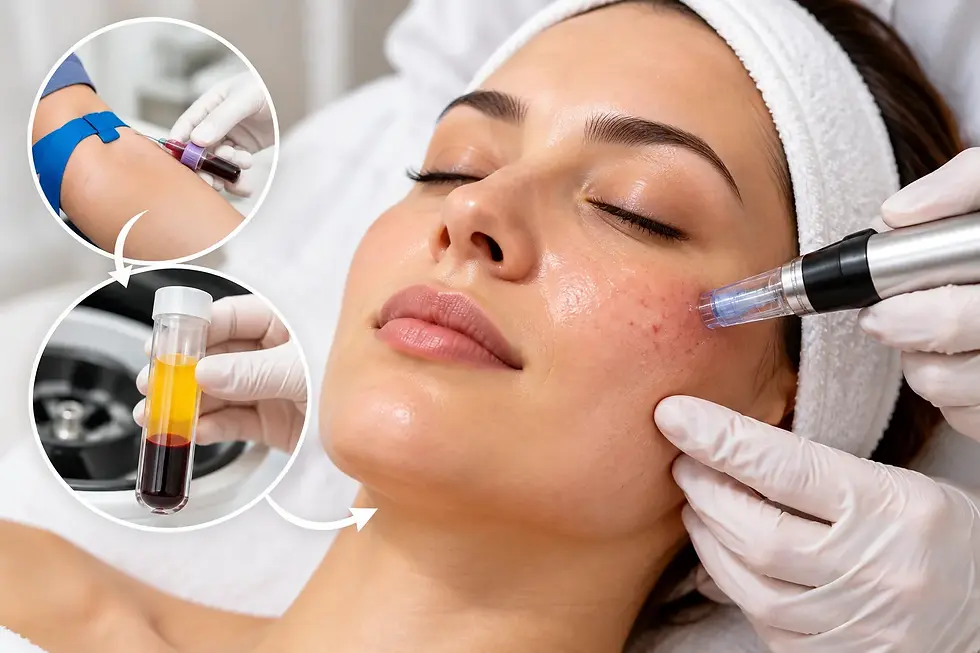
A platelet rich plasma facial begins with drawing a small amount of blood from a patient like a routine blood test. This is spun in a machine to separate out the plasma, which is rich in platelets, from the rest of the blood. The plasma is then re-introduced into the patient's skin; some clinics do this by injection, and others use micro-needles to open up tiny channels in the skin.
You may have heard it referred to as a vampire facial (though it doesn't actually involve vampires). The treatment is largely innocuous as far as negative side effects go. The idea behind it is that platelets are loaded with growth hormones to signal to the skin to repair itself. Hence the reason for using it in the first place.

How PRP Treatment Helps With Acne Scars
The majority of scars are ones where the skin has indented in on itself; this is due to the skin repairing itself improperly and forming less collagen than it should during the healing process. This means that the area of skin affected will begin to sink slightly. A PRP treatment encourages the formation of new collagen, but not quickly or massively; it's a slow and steady replacement of old collagen with new.
That's why the improvements on shallow, rolling acne scars are often seen as minimal.
Which Scars Benefit From PRP Treatment?
Now, this is one area where many blog posts are surprisingly vague. In short:
Rolling scars (shallow, bumpy indentations): usually react best to treatment
Shallow boxcar scars (usually round or oval in shape): also tend to respond well
Deeper boxcar scars: see improvement, albeit less
Ice pick scars (deep, narrow): see little benefit from treatment; PRP is usually not recommended
Raised scars: are rarely helped by treatment, and usually require a different approach
Red or brown post-inflammatory hyperpigmentation (not actual scars): usually fades on its own with time, and is best treated with other approaches
An experienced practitioner will be able to advise you on which kind of scar you have.
Realistic Results of a PRP Treatment: What to Expect
There is a wealth of scientific research into the efficacy of PRP treatment for scars, but the results are mixed: most show a degree of improvement in the texture of the skin, with a few showing significant difference for the better.
However, these results are often not significant for the kinds of severe scars many people are looking to treat, and the studies are not always large-scale.
A sensible assessment would be: improvement in texture and appearance with less definition, but not complete removal.
Most people end up needing a course. That usually means three or four treatments, about four to six weeks apart. Your practitioner might want to add a session or two after that, depending on how your skin responds.
And don't expect overnight magic. Most people see things change slowly, over a few months. If someone promises a big difference after just one session, be a bit suspicious.
Take photos before and after each treatment, ideally in the same light. Your eyes can lie to you about the appearance of your skin.
Other Benefits of a PRP Facial
A PRP facial has other benefits aside from treating scars; the benefits are fairly minor, but they're benefits all the same:
Improvements in the overall texture and tone of your skin
Fewer fine lines
A general improvement in the overall appearance of your skin, with a youthful freshness
This comes from the same collagen boost that helps your skin repair itself and swap old skin for new. Still, don't expect a big change. It won't do the job of surgery or a full resurfacing treatment.
What to Expect During a Session
The process of drawing out the blood takes a few minutes, then a numbing cream is applied to your face and left to take effect. After that, the treatment begins. Honestly, it feels more scratchy than painful. You do get used to it. Afterwards your face might look pink and feel a bit sunburnt for a while.
It usually calms down within a day or two. Some people experience slight swelling or pimple-like bumps as a result of the treatment. Don't plan anything big for the next day. And please don't book your wedding for the same day, you'll regret it. Not sure what to do afterwards? Just ask your practitioner.
Aftercare in the First Few Days After a PRP Facial
Like I said, keep the big decisions for later. Keep it simple with a gentle cleanser and moisturiser, and resist picking at any flakes. If you can, skip heavy foundation for the day. Give hot saunas and hard workouts a miss for a day or two, because heat can make the pinkness worse.
And, most importantly, wear at least SPF 30 sunscreen; the sun's rays can still damage skin even in the UK, and a PRP treatment will make your skin incredibly sensitive to it. Your practitioner will give you specific advice in addition to this, and it's best to listen to them.
Who Isn't Suitable for a PRP Treatment?
PRP treatments are not suitable for everyone. An experienced practitioner will ask you about any of the following conditions in advance:
Pregnancy or breastfeeding
Blood disorders or those on blood-thinning medication
An active skin infection or serious acne outbreak
A history of keloid or overly raised scars
Other long-term health problems
They would rather know before they begin that you fall under any of these categories, rather than having to decide what to do later.
Common Mistakes With PRP Treatment
Assuming that a single PRP session will deliver dramatic results
Looking for the cheapest PRP clinic available
Expecting miracles from a PRP treatment on ice pick scars
Failing to apply sunscreen after the treatment
Picking at or scrubbing any flaky skin
Comparing your own before-and-after pictures with those in the clinic's social media which have been heavily edited
Got Questions? Start Here
Thinking about a PRP facial? Honestly, the easiest next step is a consultation. A trained practitioner will look at your skin and tell you what makes sense. You can book online and bring every question you've got.
FAQs
Does a PRP treatment actually help with acne scars?
It helps a bit, but it won't wipe them out. It can nudge the skin to repair itself, but the old scars will still be partly visible.
How many PRP sessions do I need to help acne scars?
Everyone's different, but most people end up with three or four sessions, about four to six weeks apart.
How long will my PRP results last?
It varies from person to person, too, but most people find that they last for a lifetime. Some people require occasional maintenance sessions, however. Your practitioner will be able to advise you.
Is a PRP facial painful?
Most people describe the sensation as more prickly than painful, and the application of a numbing cream will help with this.
Is there any downtime after a PRP treatment?
Downtime is minimal after a PRP treatment; most people report pinkness and possible swelling for a day or two, and they're back to normal soon after.
Can I have a PRP facial with microneedling?
Yes, at Tama Aesthetics we offer the two treatments together, as the creation of microscopic channels in the skin allows the PRP to penetrate more deeply and, according to many studies, more effectively.
Comments