PRP Facial vs Microneedling: What's the Difference, and Do You Need Both?

Updated: Jul 22
A client walked into a clinic last month and asked something I hear all the time.
"Which one should I get, PRP or microneedling? Aren't they the same thing anyway?"
Fair question. Honestly, most people asking this have read two or three blogs already and still walked away more confused than before they started. So let's just talk about it plainly, the way you'd explain it to a friend, not a textbook.
If you're anywhere around Wallington, Sutton, Croydon or Purley and Googling this at 11pm before a consultation tomorrow, this one's for you.

Microneedling, in Plain Words
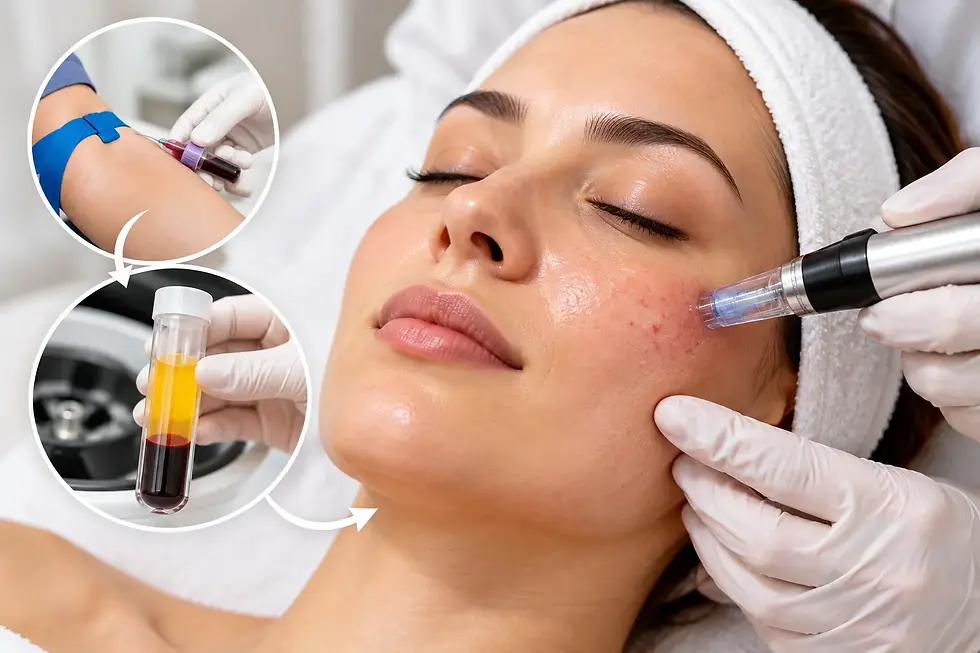
Microneedling is a device with very fine needles. It pricks your skin in a controlled way, over and over, in tiny points.
Sounds worse than it feels. Most clinics put numbing cream on beforehand, so you feel pressure more than pain.
Here's the thing though. Your skin doesn't know these are "good" injuries. It just reacts the way it reacts to any small wound, by healing itself. And that healing process is exactly what makes more collagen and elastin, the stuff that keeps skin firm.
A session usually runs 30 to 45 minutes. Your face will look a bit pink after, like you caught some sun, and that settles in a day or two.
Where microneedling helps the most:
Pores that look bigger than you'd like
Mild acne scarring
Fine lines starting to show
Skin that just looks tired all the time
If you've never had any skin treatment before and want to dip your toe in, this is usually where people start. Nothing dramatic, just steady improvement.
Where PRP Comes Into the Picture
Now here's what trips people up. PRP isn't really a separate treatment competing against microneedling. Most of the time, it's added on top of it.
PRP means Platelet-Rich Plasma. Before anything else, a small vial of your own blood gets drawn, same as any routine blood test at a GP. That blood gets spun in a centrifuge, fast enough that it separates into layers. One of those layers, the golden coloured one, is the plasma packed with platelets and growth factors.
That plasma then goes onto your skin right after the microneedling part. And this is the clever bit, those tiny channels the needles just made act like open doors. The plasma soaks in properly instead of just sitting on the surface.
This combo is what people mean by "vampire facial." Not the nicest sounding name, I know. But there's real research behind why it works, even if results vary person to person.
So if someone tells you "PRP facial vs microneedling, which wins," honestly there's no real contest happening. One usually sits inside the other.
PRP for Skin Tightening: Let's Be Honest About This
This question comes up more than any other, so I won't dodge it.
PRP is not a facelift. It will not pull sagging skin upward the way a surgical lift or thread lift does. If a clinic tells you otherwise, walk away.
That said, PRP for skin tightening in a softer sense, meaning firmer texture over time, does have genuine research supporting it. The growth factors work with your skin's own repair cycle over several weeks. Not overnight, not after one visit.
Most people need 3 to 4 sessions, spaced roughly a month apart, before they notice real change. If you're expecting a dramatic before-and-after after a single sitting, that's not a fair expectation to set for yourself.
So Do You Actually Need Both?
Depends on what's bothering you and how far you want to go.
Microneedling alone works fine if you just want general glow, your budget's a bit tighter right now, or you're new to this and want to test the waters before committing to anything bigger.
Adding PRP makes more sense if you've got acne scarring, especially the pitted kind, or you've already tried microneedling before and want more from it this time round.
A lot of clinics across South London, from Sutton down to Croydon, keep these as two separate bookable options for exactly this reason. Start plain, upgrade later if you want. Nobody's forcing you into the bigger package on day one.
Where People Usually Go Wrong
Expecting results overnight is the big one. Your skin heals on its own timeline, not yours, and that's just biology.
Going to someone unlicensed to save a bit of money is another. PRP means handling your actual blood. That needs a properly trained person with the right equipment, not a quick add-on at a salon that mainly does eyebrows.
Skipping aftercare instructions trips people up too. Your skin stays sensitive for a few days after either treatment, so sun, harsh products, heavy makeup too soon, all of that can undo what you just paid for.
And doing just one session, then giving up because "it didn't work." Real change from PRP skin rejuvenation shows up across a course of sessions, not a single visit.
Questions Worth Asking Before You Book Anything
Ask how long the practitioner has actually been doing this, not just how long the clinic's been open. Ask what system they use to prepare the PRP, since quality varies a lot between machines. And ask honestly how many sessions they think you'll need for your specific skin, not a generic number pulled from a price list.
A good clinic answers these without hesitation. If they rush you straight to buying a big package instead, that's worth noticing.
Frequently Asked Questions
Is a PRP facial the same thing as microneedling?
Not exactly. Microneedling is the needling part on its own. A PRP facial usually means microneedling plus your own plasma applied right after. One sits inside the other, they're not really competing treatments.
Does PRP hurt more than plain microneedling?
Not really, no. The blood draw feels like a quick pinch, same as any blood test. The needling itself feels identical either way since numbing cream goes on for both.
How many sessions of PRP skin rejuvenation before I see something?
Usually 3 to 4, about a month apart. One session rarely shows much on its own, so go in expecting a course, not a quick fix.
Can PRP for skin tightening replace a facelift?
No, and any clinic saying it can isn't being straight with you. PRP supports your skin's own collagen process. It's not a surgical alternative.
Is microneedling worth doing on its own if PRP's out of budget right now?
Yes, honestly. Plain microneedling still helps texture, pores, and mild scarring by itself. You can always add PRP later once you're ready for it.
Bottom Line
Microneedling is the base. PRP is what you add when you want your skin working a bit harder for you.
Neither one fixes everything in one go, and both need some patience along with the right hands doing the work.
If you're still on the fence, that's exactly what a proper consultation is for. Go in, ask your questions, let someone actually look at your skin before you decide anything.


Comments